Lockdowns and social distancing sure made me take another look at my life. I faced a new-found awareness of a need to do something productive and gratifying, and alone.
After considerable thought and investigation, I discovered pastel painting. I call it finger painting for grownups. I have begun studying the art, grateful for the Internet and the availability of so much new-to-me information.
I started with The Great Courses and took an academic approach to learning to draw. I learned about line and space, value, media, perspective, dimension, and a little more history than I really felt I needed. From there, I turned to youtube tutorials and actually spent a whole hour learning how to sharpen a pencil. (It is not as easy or as simple as you may think.) I am still watching youtube videos to learn more about types of pastels, techniques, tools, styles, and even more history.
I have thrown myself into this new endeavor.
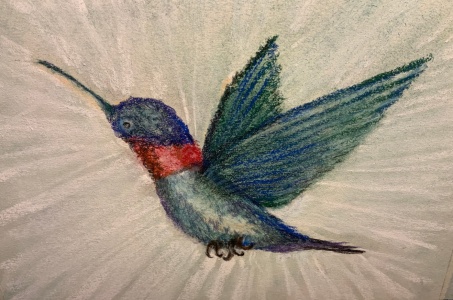
I finished this one today. I call it “Ruby Throated Hummingbird,” because that it what it is supposed to be. I will encase it behind a mat and inside a clear protective casing and then hopefully find a place to hang it.
So what do you think?
Pictured: Pastel painting of a ruby throated hummingbird, with green wings and body and red throat.
Stay fit. Stretch, strengthen, tone, condition, and relax your body with a series of FREE downloadable exercises from Blind Alive. The series is called Eyes-Free Fitness.
Blind Alive has put together a series of 22 downloadable audio files that provide physical exercise programs that are fully audio described. The variety of audio exercises include meditation, balance, yoga, pilates, cardio workouts, strength training, and more.
Click on the following link to access the Blind-Alive Eyes-Free Fitness downloadable audio exercise files:
My granddaughters love their dolls. One has an Adora toddler doll she named Scarlett, a 20-inch tall doll that weighs a full 2 pounds! The other has the ever-popular Barbie doll. Both dolls need lots of care, and lots of clothes, naturally.
Pictured: This is Scarlett sitting pretty in her new crocheted dress. The dress has stripes of colors that blend gradually from reds to pinks to a bright yellow hem . The skirt is V stitches with a scalloped border.
Pictured: Scarlett has her back to us now. Don’t worry! She is not mad or upset. She is just showing us the back of her dress with button at the upper back. – Photos by Emilia, age 11.
Pictured: Barbie is wearing a fitted yellow dress with spaghetti straps. Not shown is the low cut back. Barbie has accessorized with a red hair ribbon. – Photo by Sidrah, age 9.
The abacus was invented in approximately 500 BC. It functioned as a counting device for centuries. It dates back to a time when written numbers did not yet exist. Merchants used the abacus to track inventory; farmers used them to count animals returning from the pasture. The abacus has evolved and been adapted by different civilizations and groups over the centuries. Essentially it is rows of stringed wire within a frame with a set number of movable beads on each row and column.
I have a Cranmer abacus. I took a course to understand its function and how to manipulate the beads. I am just nerdy enough to have enjoyed that course. But, the course is over and I have this nifty counting device at hand. I found the perfect use for it.
My abacus is my stitch counter. It also functions as my line-by-line stitch instructions. It keeps my place, counts my rows, and shows me my stitch pattern. It is handy, lightweight, practical, portable, and fits in the palm of my hand. It does not rely on electricity or batteries, devices, or apps. It is the handiest crochet accessory I have used yet, second only to the hook itself.
My Cranmer abacus measures 6 inches wide by 3 inches tall, and is held horizontally. The beads line up vertically in columns. It is divided by an upper row of only one bead in each column and is separated from the bottom section by a bar. The bottom section has four beads in each column. Since crochet is usually worked from right to left, my bead arrangements follow that same pattern.
Pictured: My Cranmer abacus for my current project. It shows that I have completed 4 rows. The 5th row will be worked with 4 chains followed by a single crochet and this pattern will be repeated across the row. A crochet hook is shown above the abacus demonstrating the abacus to be about the same width as the crochet hook is long.
I use the top section to count rows. Every time I complete a row, I move one bead from the top section down toward the separating bar. When a second row is complete, I move the 2nd bead from the right down. After I have completed 10 rows, I mark the 11th row by returning to the far right bead and now moving it to the up position away from the bar. My abacus has 13 columns. I use the last 3 column of the top row on the left to count sections or other pattern-specific things.
Now the stitches. For these, I use the beads in the bottom section.
If I am crocheting a single crochet across the row, I move 2 beads up toward the bar in each column all the way across to the left. Two beads is my bead code for single crochet.
Pictured: Cranmer abacus. Top row has first 3 beads on the right moved down indicating completion of the 3rd row of the crochet project. The bottom section has 2 beads moved up in each row across indicating a single crochet is to be worked for every stitch in that row of the crochet project.
If I am working a double crochet stitch across a row, I move 4 beads up to the bar across the row. Three beads is my code for half-double crochet.
If I am crocheting a pattern, I indicate the pattern with one bead up for a chain stitch (to create a space between stitches) , two beads up for a single crochet, 3 beads up for a half double crochet, four beads up for a double crochet, and so on. If my pattern is 2 single crochets, 1 chain, and 2 single crochets, I move 2 beads in the first column, 2 beads in the second column, 1 bead in the 3rd column, 2 beads in the 4th column, and 2 beads in the 5th column. I can see or feel at a glance what the pattern across the row will be. (Pictured below)
Pictured: Top row – 4 beads down indicates 4 rows have been completed. Bottom section shows the pattern to be worked for the next row which is 2 half-double crochets, a chain stitch, and 2 more half-double crochets. This would be repeated across the 5th row.
I can count my crochet rows and stitches until the cows come home!
So many choices! Books and magazines in various formats including print, ebooks, audiobooks, and braille. Selections cover every topic and genre imaginable – from current bestsellers to classics, fiction and nonfictioin. Take your pick!
This list is primarily for an American audience. Readers from other countries may find similar services with the help of a little googling and perseverance.
1. American Action Fund – Sign up to receive in the mail a free braille children’s book – one every month.
Pictured: Screenshot of the American Action Fund website, and link.
2. BARD – Audiobooks and magazines ready for immediate download without limits or wait times from the National Library Services. Membership required.
Pictured: Screenshot of the BARD website, and link.
3. Bookshare – eBooks galore and braille books in BRF, all ready for download. Currently there are 729,659 titles with more added all the time. Membership is free to students
Pictured: Screenshot of Bookshare website, and link.
4. National Library Services – Coordinates with local talking book libraries. Membership and eligibility required. A free digital audio player is provided that is fully accessible.
Pictured: Screenshot of the National Library Services, and link.
5. Project Gutenberg – Project Gutenberg offers over 59,000 free eBooks. Choose among free epub and Kindle eBooks, download them or read them online. You will find the world’s great literature here, with focus on older works for which U.S. copyright has expired.
Pictured: Screenshot of the Project Gutenberg website, and link.
Pictured: Screenshot of Sharebraille website, and link.
7. SightExchange – An e-mail list for the free exchange of any blindness-related item. Braille books and magazines are frequently offered. Membership required, as well as requirement to share a minimum of one item per year.
Pictured: Screenshot of SightExchange website, and link.
8. YouTube – Complete audiobooks are just a listen away. Go to YouTube.com, or download the YouTube app to your device
Pictured: Screenshot of YouTube website, and link.
9. Your local library – Many local libraries have print books and magazines and audiobooks to lend as well as ebooks and digital books available for download. Most public libraries also have videos and TV shows on CDs for circulation. Membership usually required and subject to local rules and regulations.
Pictured: Screenshot of public library bookshelves lined with books.
Men do it, women do it, even dedicated blind do it. So grab your hooks or your needles and let’s look at some tips to make yarn crafts more accessible, organized, and fun.
Pictured: Crocheted items include hotpad, hat with pompom, scarf, and towel holders.
Tip #1
Good lighting. A task light can be the best tool of all.
Pictured: A desk lamp with soft-light fluorescent bulb is designed for task lighting. The head can be positioned and directed as needed. This lamp is directed on a cone of red cotton yarn and a crochet hook with beginning slip knot.
Tip #2
Use chunky yarn and larger hooks and needles. Larger gauge materials are easier to work with. With some experience, common 4-ply yarn can be doubled and even tripled for some projects.
Pictured: Two skeins of red yarn. On the left is worsted weight and on the right is super chunky. The super chunky yarn is much thicker and requires a much larger crochet hook, as shown.
Tip #3
Use large print or audio pattern instructions. (Duh!)
Pictured: YouTube icon. YouTube has many crochet tutorials and patterns in audio format.
Tip #4
Consider loom knitting. Loom knitting can be easier to work with, especially for newbies, with fewer dropped stitches.
Pictured: A pink knitting loom with a pink knitted hat in progress.
Tip #5
Use paper clips as stitch markers. The colorful vinyl-coated paper clips work well with little or no snagging. The paper clips are also great as a place holder at the end of your knit/crochet session. Slip a paper clip through the last stitch, and even the cat won’t be able to unravel your work overnight while you sleep.
Pictured: Six paper clips, all vinyl coated, assorted colors.
Tip #6
Use plastic blunt-tipped needles for weaving in all those ends at project’s conclusion.
Pictured: Three blunt-tipped plastic sewing needles with large eyes for working with yarn.
Tip #7
Use a needle threader. Some needle threaders are better than others. The needle threader pictured below is my favorite. I have been using just one of them for years now. I have not needed to use any of the backup threaders.
Pictured: Three identical flat metal needle threaders. Each has a small hook on one end for threading embroidery threads and a larger hook at the opposite end for threading yarns of various types.
Tip #8
Keep a magnet in a small sewing box with your needles. This will save you from crawling on your hands and knees hunting for that dropped needle or pin. A magnet holds onto my needle threaders too.
Pictured: A small metal box with two magnets inside, one on the inside lid and one on the inside bottom. Paper clips and needle threaders are held in place by the top magnet, and sewing and embroidery needles are held in place by the bottom magnet.
Tip #9
Store project – all yarn, hooks, instructions, etc. – in a plastic bag or box. Keep a written or voice recorded record of yarn type and color, hook/needle size, and any special instructions. You might add the date in case it becomes a time capsule.
Pictured: A clear plastic zippered bag with crochet project, working yarn, crochet hook and written instructions inside. The instructions card says: Hat, Caron Simply Soft white, hook H, scrap colors #4.
Tip #10
Keep your working yarn in a container to keep the yarn balls from rolling around and onto the floor. A colander works well for multiple balls of different colors. A coffee can can be repurposed to fit the need, as can a shoe box or almost any other container.
Pictured: A colander with two skeins of yarn (one pink, one white) with yarn ends poking through colander holes from inside to outside. A crochet hook is seen with white yarn ready to be worked.
Bonus Tip
Replace your sewing straight pins with sewing clips. When you drop one without even knowing it, sewing clips are so much less painful to step on!
Pictured: Four sewing clips of various colors. Each clip is pressed open and clamps onto the fabric much like a miniature clothespin.
__________________________
The following products are presented for information only. They are not specifically endorsed.
Pictured: Two tactile playing cards. These two standard playing cards have braille labels imprinted on them – the Queen of Spades and the three of Hearts are shown.
Card games are fun for everyone. Well, maybe not “52 Pickup,” but every other card game I can think of, and there are so many! Blind and visually impaired people can and do share in the fun. We play with a marked deck!
It is true. The cards are marked!
Any deck of cards can be adapted. Making playing cards tactile is the way. Just add braille! A few raised dots, inconspicuous to sighted players and likely unreadable also, tell the visually challenged player exactly what cards are in hand.
Add braille to the upper left-hand corner and the bottom right-hand corner (opposite corners). Each card is brailled with the corresponding number or J, Q, and K for jack, queen, and king. In addition, the cards are marked with the corresponding suit. So the 3 of hearts is marked with the brailled 3 and brailled H for hearts. The 4 of spades is marked with the braille for 4S, the 9 of diamonds will be 9D. The only exception is the number 10. Because the number 10 requires 3 digits including the symbol for the suit, and all other cards have only 2, that might be an attention-getter. So, the 10 is labeled with a brailled X instead.
If you are blind or visually impaired, it is fairly easy to learn just the braille that is used on playing cards if you do not already know braille. There are only a total of 17 different braille symbols to a standard deck of cards and all 52 cards are uniquely identified with combinations of just those symbols.
A slate and stylus is all that is needed to turn an ordinary deck of cards into a tactile deck. Or you can spend a few dollars and buy a brailled deck of cards. Your choice.
Pictured: Chart shows the 17 braille symbols used on tactile playing cards. Symbols include numbers 1 through 9, a special braille character for number 10, the four card suits, and the J, Q, and K for the picture cards.



 Legally Blind