9 Ways to Get Free Books

So many choices! Books and magazines in various formats including print, ebooks, audiobooks, and braille. Selections cover every topic and genre imaginable – from current bestsellers to classics, fiction and nonfictioin. Take your pick!

This list is primarily for an American audience. Readers from other countries may find similar services with the help of a little googling and perseverance.

1.     American Action Fund – Sign up to receive in the mail a free braille children’s book – one every month.


American Action Fund
Pictured:  Screenshot of the American Action Fund website, and link.

2.     BARD – Audiobooks and magazines ready for immediate download without limits or wait times from the National Library Services.  Membership  required.

BARD
Pictured:  Screenshot of the BARD website, and link.

3.     Bookshare – eBooks galore and braille books in BRF, all ready for download. Currently there are 729,659 titles with more added all the time.  Membership is free to students

Bookshare
Pictured:  Screenshot of Bookshare website, and link.

4.     National Library Services – Coordinates with local talking book libraries.  Membership and eligibility required.  A free digital audio player is provided that is fully accessible.

NLS
Pictured:  Screenshot of the National Library Services, and link.

5.     Project GutenbergProject Gutenberg offers over 59,000 free eBooks. Choose among free epub and Kindle eBooks, download them or read them online. You will find the world’s great literature here, with focus on older works for which U.S. copyright has expired.

Gutenberg
Pictured:  Screenshot of the Project Gutenberg website, and link.

6.     ShareBraille – A free service from the American Action Fund for Blind Children and Adults that facilitates the exchange of Braille books through an online community-run library.

Sharebraille
Pictured:  Screenshot of Sharebraille website, and link.

7.     SightExchange  –  An e-mail list for the free exchange of any blindness-related item.  Braille books  and magazines are frequently offered.  Membership required, as well as requirement to share a minimum of one item per year.

SightExchange
Pictured:  Screenshot of SightExchange website, and link.

8.     YouTube – Complete audiobooks are just a listen away. Go to YouTube.com, or download the YouTube app to your device


YouTube
Pictured:  Screenshot of YouTube website, and link.

9.     Your local library – Many local libraries have print books and magazines and audiobooks to lend as well as ebooks and digital books available for download. Most public libraries also have videos and TV shows on CDs for circulation.  Membership usually required and subject to local rules and regulations.

Public Library
Pictured: Screenshot of public library bookshelves lined with books.

______________________________________________

Talk to me! I’d love to hear from you! 

← Back

Thank you for your response. ✨

Warning
Warning
Warning

Warning.

Novel Characters

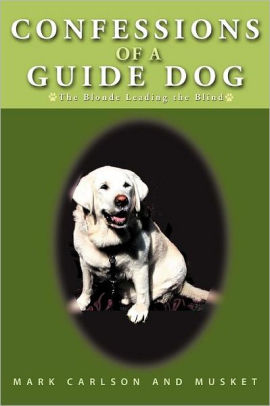
Confessions of a Guide Dog: The Blonde Leading the Blind
       Pictured: Book cover – Confessions of a Guide Dog

 Are you looking for a good book?

The following list of novels features characters who are blind or visually impaired.  All of these books stand out as great reads and are recommended.  This list is a work in progress.  Additional books featuring characters who are blind or visually impaired will added to this list as they become known.  This page can be accessed at any time under the BOOKS tab at the top of this and every page on this blog.

Click on a hyperlink if you are interested in reading my review.

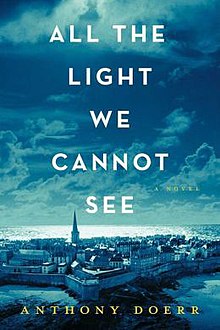
  1. All the Light We cannot See by Anthony Doerr

  2. Blind Curve by Annie Solomon

  3. Blindness by Jose Saramago

  4. Confessions of a Guide Dog by Mark Carlson and Musket

  5. Girl, Stolen by April Henry – young adult

  6. Seeing by Jose Saramago (sequel to Blindness)

  7. The Fault in Our Stars by John Green

Image result for all the light we cannot see
Pictured:  Book cover      –  All the Light We Cannot See

A


Audiobook: The Silent Patient

by Alex Michaelides

Alicia Berenson shot her husband in the face five times.

She and Gabriel had lived a very comfortable life, she a famous painter and he a notable fashion photographer.  One night, he came home late, at 11 p.m., after a photo shoot when Alicia pulled the trigger.  Alicia did not admit to the murder, she did not speak of the crime.  In fact, she did not speak again.  She was taken to a facility, away from public scrutiny, and there psychotherapists tried to work with her.

Theo Faber was fascinated by the case.  He worked long and hard to find his way into her world.  As a psychotherapist, he was pleased to finally be assigned to work with Alicia in a dual effort to satisfy his curiosity and unlock her secrets that so far were sealed away without words.

A comparison emerged between Alicia Berenson and Alcestis, a woman from Greek mythology, presented by Euripides in a Greek tragedy.  Alcestis was a woman who sacrificed her life to bring her husband back from the dead.  Is that why Alicia did not speak?  Or was it perhaps her tormented mind that crawled to a halt and sequestered her words.

This is a psychological thriller with lots of twists and turns, and even one audible gasp from me!  A page turner for sure.

The Silent Patient
Pictured: Book cover for The Silent Patient, print edition.

_____________________________

The Silent Patient by Alex Michaelides is available as a free downloadable audiobook from BARD for all National Library Services members.


Can We Talk?

Do you see what I see?  Can you see what you can’t see?  What is it, and how do you know?

Assistive devices for vision impairment can be very helpful, and very expensive.  CCTVs, braille writers, magnifiers, and audiobook players cost hundreds, even thousands of dollars, to name just a few things that could help blind and visually impaired people.  Even audiobooks can be beyond our budget.  Too often, even tools that can help us with our daily activities and special needs are not even made available for us to try, or even know about.  And then, can we afford them?  We must rely on word of mouth, and even then the results can be disappointing.  It is not like I see what you see, or that you see what someone else sees.  With vision impairment, we all see (or don’t see) the same things differently.

Talking about different devices can often lead to success.  Even better, there are so many common household items and stationery supplies, and even things we never gave much thought to that provide so much benefit.  Sometimes we just have to think outside the box.

For example, did you know you can cook perfect bacon in the oven instead of a fry pan and avoid all the hot oil spatter?  Did you know a child’s whiteboard can be the perfect tool for your notes and reminders?  Did you know you can easily connect your tablet to your computer screen or TV so you can benefit from greatly enlarged print and images?  Did you know there is an online group that gives away used audiobooks and braille books, magnifiers, and more?

We have a lot to talk about.  So let’s explore together.

Thanks for joining me on this journey.


Talk to me.  I would love to hear from you!

← Back

Thank you for your response. ✨

Warning
Warning
Warning

Warning.