Pictured: Four keys on a silver key ring. Two of the keys have brightly painted tops, one white and the other pink. The two remaining keys are unpainted.
How many keys do you carry with you? I have four keys on my key ring. Sometimes it is hard to tell which key I need in the moment.
My four keys can be distinguished by size and shape. There is one small key, two medium sized keys, and one large key. Unlike the others, the large key has a square shape to it. It is the two medium sized keys that often pose a problem. Left in their original state, It is difficult to distinguish them due to their similar size and shape.
There are a number of ways to customize keys so that they can be distinguished by touch and by sight. Your vision can impose more specific needs. So here are some ideas.
Pictured: A selection of customizing materials. There are bump dots of various sizes, colors, and textures, two jars of nail polish (one white and one pink), and a braille label maker.
Place a bump dot at the top of the key used most often. A second key might have two bump dots, and a third might have a bump dot on the front and back of the top of a key. Bump dots are available in different sizes, shapes, colors, and textures,so finding what works bests for you offers many choices.
Add braille by using a braille label maker. A brailled F for front door and a B for back door or M for mail might prove helpful. These are just suggestions to get you started.
Paint the tops of your keys with nail polish. Nail polish is very durable. There are lots of colors to choose from, even glow-in-the-dark types. I painted my 2 medium sized keys with nail polish to differentiate them – one white, one a dark pink.
Customizing the look and feel of your keys could be your key to success.
It is so quick and easy to put on a few pounds, and so very hard to take them off. So I like to keep track of my weight. I weigh myself at a set day and time every week. By doing so, I can catch any weight gain early on and work to reverse that trend before it is out of control. But it is so hard (admittedly impossible) for me to see the scale when I stand on it.
I like to keep my weight private. So asking someone to read the number to me is not my first choice. It may also be an inconvenience or an imposition for the sighted assistant. An alternative could be a talking scale, but that is expensive and the darned battery needs changing far too often. The talking scale is not the most accurate scale around either.
I figured out a way to weigh.
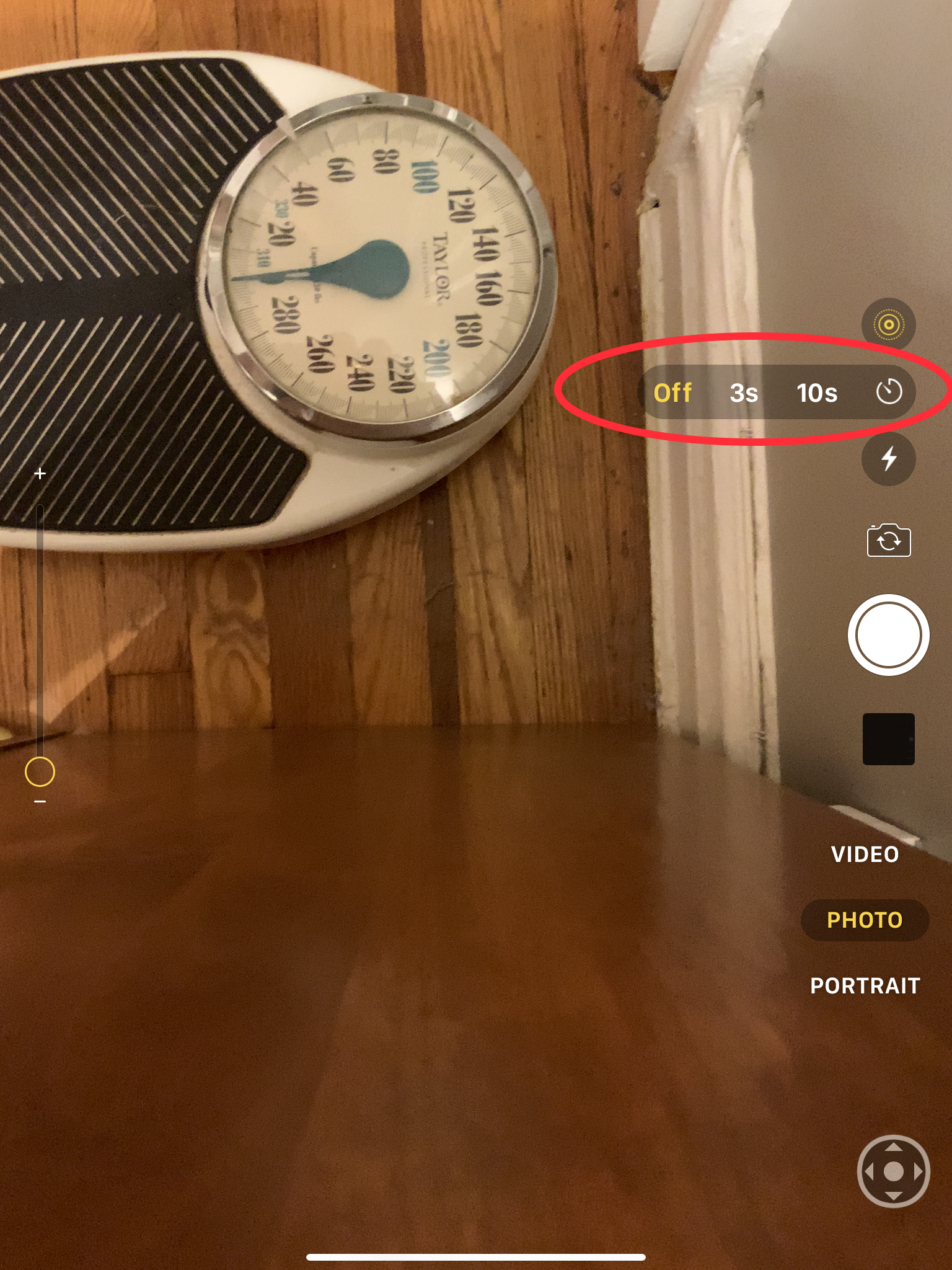
Pictured: The camera screen is displayed. The second button from the top along the right side of the screen is the self-timer button. If you are using your iPhone, the self-timer button will be at the top of the screen. The red circled area shows the choice of OFF, 3 seconds, or 10 seconds for the self-timer.
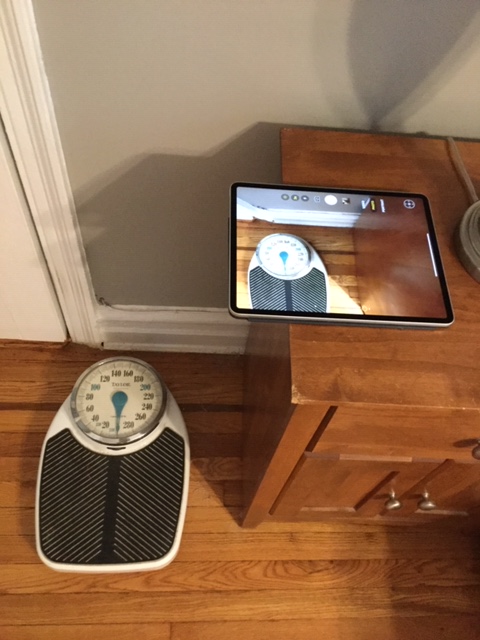
I place the scale on the floor next to a counter or table. I open the camera on my iPad and set the self-timer to 3 seconds. Then I place it on the table with the camera lens extended over the edge of the table. I check to be sure that the scale is visible on the iPad screen. Then, while standing steady on the scale, I gently push the START button on the iPad’s camera. Voila!
Pictured: The iPad in on a table and on the floor to the left is the scale.
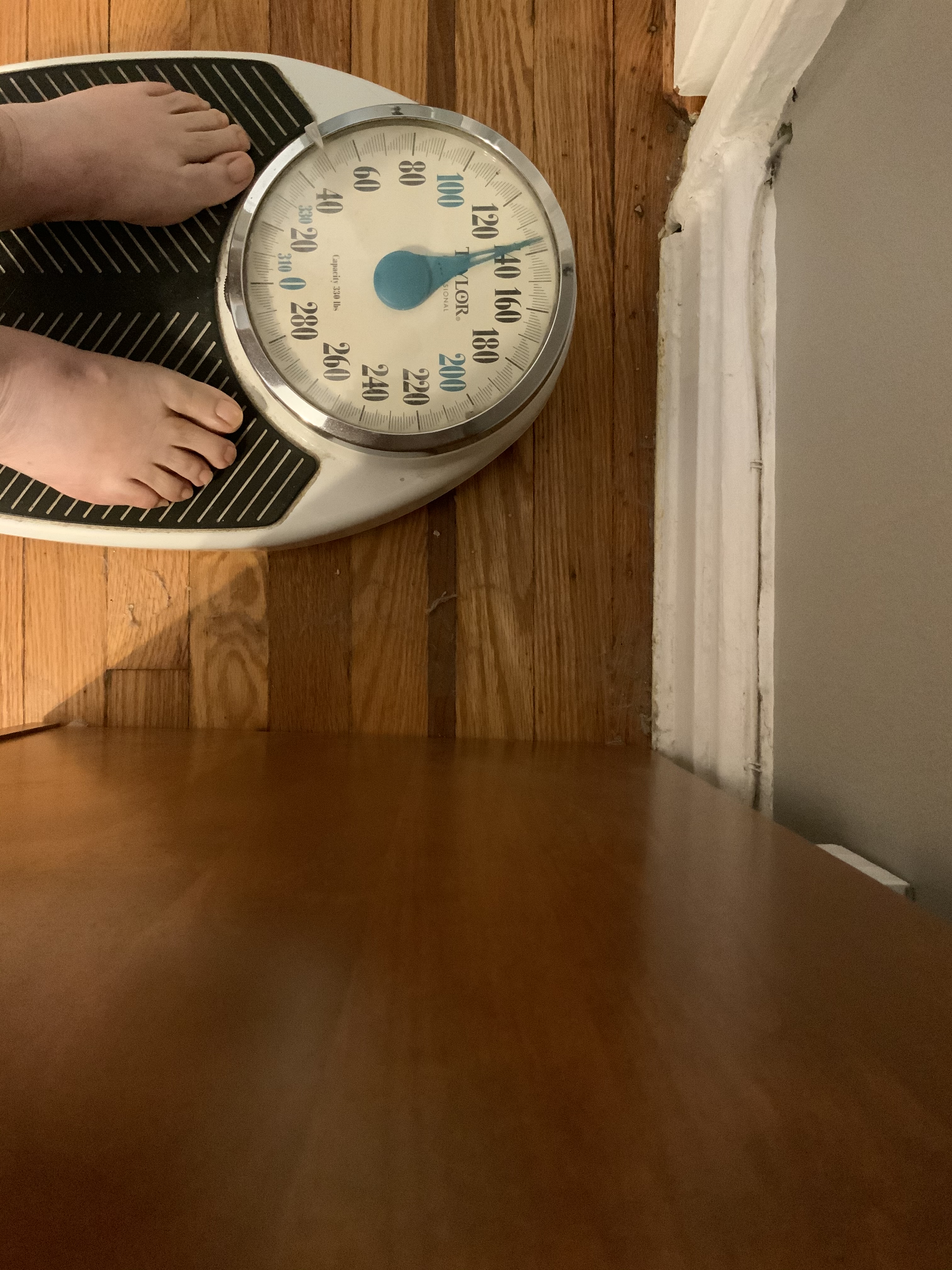
Pictured: My tootsies on the scale. The image is captured by the iPad camera.
The iPad’s camera now has the image of my scale with my current weight displayed. Now I can pinch and stretch the on-screen image to enlarge that portion of the screen.
I can see it! I can see the image of the scale with my weight displayed. On, so easy! I found a way to weigh!
Two weeks ago it was 93° here in New York City. Now it is Poncho Time!
I am not partial to big crochet projects. They can be unwieldy to work on, and become heavier and heavier as they grow. I don’t know why I thought a poncho would be a quick and easy project. Easy? Yes. Quick? Not at all!
Nevertheless, my poncho is done and in time for fall. It is warm and comfortable.
I used a medium weight 4 Caron Simply Soft yarn and a size J hook. The project started at the neckline with a chain of 76 and worked down to the hem, growing with every row. It it is Back Loop Double Crochets with an increase at each arm and a double increase mid front and mid back. It is trimmed with a scalloped border at bottom and 3 rows of single crochet added to the neck with a small notch at neck front.
Pictured: That’s me wearing the poncho described above. Color is Minty Blue, according to Caron. At my feet is my usually shy 25-pound cat Ernie.
Pictured: A thick fuzzy crocheted dusting mitt is shown swiping dust from window blinds.
Sometimes things look way better than they really are!
Several years ago, I saw a youtuber demonstrate the use of a kind of yarn I had never seen before. It was Bernat Tizzy yarn. (Apparently, this particular yarn had been recalled in 2015. Nevertheless, similar yarns are available.) This is a chunky yarn with lots of little ends hanging off the main strand. The yarn is also variegated – a fuzzy yarn that changes colors too. This funky yarn was designed to create a product with lots of texture and color. It looked like fun. I ordered a skein.
I was excited when the yarn arrived and I began to work with it right away. I had never worked with any fancy yarn before so the whole thing was new to me. I tried to create the foundation chain, ripped it, and tried a few more times. After some time, I managed to complete that foundation chain and went on to try and work a single crochet in each chain stitch. After numerous attempts, I dropped the project. All I had created was frustration.
The other day I watched another youtube video, this one using a similar crazy yarn. The youtuber had made a dusting mitt. She raved about her project. The crazy yarn made a great duster, she said. It looked cute.
So I pulled out my skein of yarn that has been tucked away for years and decided to try again. I simplified the youtuber’s pattern though, and made a dusting mitt in the round – just one piece – no sewing, no fuss. And after an hour or so, it was done.
Pictured: A single strand of funky yarn in varying shades of pink. There are small pieces of yarn coming off of the main strand for the purpose of creating a thick fuzzy knit or crochet project.
This yarn is difficult to work with and I would never spend hard-earned money on such a type of yarn as this again. However, today it worked. Because of its thickness, I was able to feel my way even though the stitches were buried beneath the fluff. If there are errors, no one will ever know! And it is a dusting mitt; if there are errors, who would care!
My dusting mitt turned out great! It picks up dust easily from tabletops to window blinds. It goes in the washer and dryer. Best of all, I got rid of some crazy yarn that, until now, was just taking up space.
Pictured: DIY Shower Cleaner, bottle of Dawn dish detergent, and DIY All Purpose Cleaner.
Original blue Dawn has so many uses. It has been tried and tested and proven to be safe and effective. For people who are blind or visually impaired, it is best to minimize the toxic cleaners we think we need in order to keep our homes clean and manageable. Of course, this is best for everyone, not just the VIP community. Instead of a shelf full of assorted bottles and jars that can be harmful and confusing, try paring down your cleaning supplies with a few very effective nontoxic cleaners.
Remember to label all of your bottles containing homemade cleaning products. Use a bold indelible (permanent) marker and/or a braille label maker.
Be safe and save money!
1. All Purpose Cleaner
Keep a bottle of all purpose cleaner handy. Wipe fingerprints from walls and dirt and spills from tile floors. It is great for removing grease and scum from kitchen cabinet doors and hardware, and cooktops too.
Spray all purpose cleaner in pots and pans after cooking and let stand while you enjoy your dinner. Then wash pots and pans as usual, but with amazing ease.
Ingredients – Fill a spray bottle with 1/3 Dawn, 1/3 distilled vinegar, and 1/3 water. For more difficult jobs, spray and let stand for 10 minutes, then wipe clean. Note: Vinegar does not behave on stone (porous) countertops including marble, granite, etc., so use Dawn without vinegar on such surfaces.
2. Carpet spot cleaner
Apply a few drops of dish detergent to the soiled carpet area. Scrub with brush, even an old toothbrush. Let stand for 5 minutes or so. Rinse with just a little clear water. Blot dry.
3. Shower and bath cleaner
Prepare all purpose cleaner as above. Spray down shower walls, bathtub surfaces, and especially faucets. Let stand for a few minutes. Then rinse and wipe clean. I leave a filled spray bottle in the shower and spray faucets and known problem spots at the beginning of the shower. At shower’s end, I just wipe clean. The shower practically cleans itself.
4. Ice Pack
Fill a good quality zippered sandwich bag ¾ full with Dawn. Remove excess air. Place in freezer. This DIY ice pack will be soft and malleable and will remain cold longer.
5. Clean your eyeglasses
Just place one drop of Dawn on each eyeglass lens, rub with fingertips over both sides of the lenses, and rinse clean. Dry with a microfiber cloth.
And my favorite…
6. Unclog the toilet
Pour about a cup of Dawn dish detergent into the clogged toilet bowl. Let stand for about 15 to 20 minutes. Then flush. Repeat if necessary, but it probably won’t be necessary.
BONUS:
7. Bug spray
Fill a spray bottle with water and add just about 2 teaspoons of Dawn. Shake. Spray directly on targeted insect. Bugs do not die instantly, but still quickly.
This simple crochet project helps to keep all of your crochet accessories in one place. It is portable, pretty, and handy. It requires only some leftover yarn.
Are you thinking gift yet?
Pictured: Crochet Caddy in a solid forest green color. It is about 5 inches wide and 10 inches tall. It is held closed by a small strap with a decorative 1-inch diameter white button.
Pictured: Crochet caddy in open position. The inside is in view. It measures approximately 11 inches wide and 10 inches tall. Two stitch markers are in place on the upper left and a small scissors is tied in place next to them. Three threaded embroidery needles are in place on the upper right. Seven crochet hooks are held in place by weaving them vertically through the crochet fabric.
A longhand pattern for newbie crocheters and for ease of access with screen readers is available. Click on the link that follows:
When I want to see things, I hold them close, very close. Reading is possible if the letters are big enough and held close enough. But how long can I stay hunched over a book or a chart, or whatever? How long until my wrists and shoulders ache from holding up a heavy book or even a one-page instruction sheet? Not very long! It takes just minutes, sometimes just seconds, before my neck and especially my back start to ache unbearably. So I have found ways to hold things close, and at just the right height and angle.
So here are 9 ways I have found to hold things close.
Pictured: Silver phone stand by Belkin – one position only, but folds compactly for portability.
I bought this Belkin cell phone stand in 2012 and I still use it frequently. I like to keep my phone propped up with speakerphone turned on, especially for group conversations. There are times when I use it to support my iPad for skype chats. It is very small, just 3” x 5”. It folds up compactly and is easy to carry with me. I don’t think this particular one is still available, but you get the idea.
Pictured: An iPad held by a flexible black metal arm that is clamped to a table. The arm can move in any direction side-to-side and up and down.
I use this for applying my makeup, and fixing my hair. I use an old iPad that is no longer supported by Apple and so I can’t download any of the newer software. It has become my grooming station. I use a magnifier app to help with makeup, and the camera to snap selfies that I then enlarge (a lot) to check out the results. With this iPad holder, I can move the arm up, down, this way or that – exactly where I need it with just a light touch.
Pictured: Belkin tablet stand for great support of heavier tablets and more. It can be easily positioned up and down to any angle, including parallel to the table.
The tablet can be moved up and down to almost any angle and the tablet is always held securely. I like to place the iPad parallel to the table. Then I hang just the camera end over the side. I can capture documents by photo or scan and send them to my computer for enlargement and manipulation. This stand is sturdy enough to easily hold my iPad Pro. It also supports my big whiteboard (16″ x 20″) while I write notes and reminders.
Pictured: Bamboo book stand has 4 tilt positions and strong metal arms that can be positioned to hold your book in place with pages held flat.
I love bamboo because it is ecologically friendly. This book stand is super sturdy and holds even large or heavy books open so that the pages are flat. I prop this up to where it works best for me.
Pictured: Bamboo lap desk. The main section of the top can lie flat or be raised to tilt in 4 positions with ledge to keep a book or laptop from slipping. About 1/4 of the table remains flat to hold additional materials. A side drawer pulls out to store small stationary supplies.
More bamboo, and still loving it.
This bamboo laptop desk can be placed over he lap when seated on a chair or couch, or even sitting up in bed. I love the look and feel of this, its versatility, and its small convenient drawer. It can be used as a flat table or angled in four different positions.
Pictured: A lap table with 4 height positions and 4 tilt positions. It has guards to prevent items from slipping off the tabletop. Extra wide surface and super sturdy, yet very lightweight. Here it is on top of another table, where I like it best.
I call this my Tabletop Table because I use this versatile table on top of another table. I use it for close work, like drawing, or projects that will take me some time. With this, I have less bending forward to see what I am doing. I am more comfortable and I can work for longer periods of time. It sure saves my neck and back from aching. It has a large writing surface. This one measures 20″ x 12″ and there is a larger version also available. The legs can be extended in a choice of heights, bringing the material closer and closer to me as needed, and then the table can tilt to four different angles. This has become my favorite accessory.
Pictured: A small silver tablet holder. The base is flat on the table and rolls around the back and up in a fixed position to support the flexible area that actually holds the tablet. This part easily moves to angle the tablet.
My newest addition. This is a small tablet stand that I use to hold my smaller whiteboard which measures 11” x 14”. I keep it next to my computer. It makes jotting down notes or reminders easy-peasy. Plus, it is portable and adjustable and I can easily carry my whiteboard and stand from room to room as needed. This small tablet stand works great for me most of the time, and is one-quarter of the price (under $15) of the larger Belkin tablet stand I talked about above.
8. Recipe Holder
Pictured: A white plastic clothes hanger with 2 binder clips clamped on holding a large print recipe. It is hanging from a kitchen cabinet knob. This recipe is for homemade Play-Doh (for the kids to play with).
We used to call this a “Rube Goldberg” machine. It is a simple DIY, and one of my favorite things. It is a plastic (or wire) clothes hanger, like the ones you get free with purchase from department stores. Just clip your recipe to the hanger and hang in your kitchen work area from a cabinet knob or handle. If you don’t have a hanger with clips attached, how about using a couple of binder clips clamped onto a hanger you already have.
9. Arms
Pictured: The hug! Here the author is hugging a man. Okay, my husband.
When you want to hold a person close, it is your arms that are most appreciated. Hugs, everyone!
How many hats will I crochet before I figure out what I really want? Answer: A lot!
I have tried a lot of patterns in the last month. I even created several hats to completion that were quickly frogged. I thought I wanted a floppy summer hat. I was wrong!
I do not think crochet and floppy summer hats go together. Each hat was much too heavy. Some of them looked cute, but the weight was too much.
So I turned my attention to newsboy hats: a simple hat with a visor. Every one I found seemed to also be more appropriate for winter, according to the yarn used and bulky stitches. So I found one pattern I liked best and modified it.
I made a simple hat using 100% cotton for its breathability and worked double crochet stitches for the hat itself to keep the hat light and airy. I added a visor brim with several rows of single crochet by first adding a braid around the base of the hat to give the hat a better fit as well as a more interesting edge. And voilà!
Pictured: The author wearing the newly crocheted newsboy hat, front view.
Pictured: The author wearing the newly crocheted newsboy hat, side view.
The longhand pattern can be found under the CROCHET tab on the menu at the top of this page, or just click HERE for the pattern.
Men do it, women do it, even dedicated blind do it. So grab your hooks or your needles and let’s look at some tips to make yarn crafts more accessible, organized, and fun.
Pictured: Crocheted items include hotpad, hat with pompom, scarf, and towel holders.
Tip #1
Good lighting. A task light can be the best tool of all.
Pictured: A desk lamp with soft-light fluorescent bulb is designed for task lighting. The head can be positioned and directed as needed. This lamp is directed on a cone of red cotton yarn and a crochet hook with beginning slip knot.
Tip #2
Use chunky yarn and larger hooks and needles. Larger gauge materials are easier to work with. With some experience, common 4-ply yarn can be doubled and even tripled for some projects.
Pictured: Two skeins of red yarn. On the left is worsted weight and on the right is super chunky. The super chunky yarn is much thicker and requires a much larger crochet hook, as shown.
Tip #3
Use large print or audio pattern instructions. (Duh!)
Pictured: YouTube icon. YouTube has many crochet tutorials and patterns in audio format.
Tip #4
Consider loom knitting. Loom knitting can be easier to work with, especially for newbies, with fewer dropped stitches.
Pictured: A pink knitting loom with a pink knitted hat in progress.
Tip #5
Use paper clips as stitch markers. The colorful vinyl-coated paper clips work well with little or no snagging. The paper clips are also great as a place holder at the end of your knit/crochet session. Slip a paper clip through the last stitch, and even the cat won’t be able to unravel your work overnight while you sleep.
Pictured: Six paper clips, all vinyl coated, assorted colors.
Tip #6
Use plastic blunt-tipped needles for weaving in all those ends at project’s conclusion.
Pictured: Three blunt-tipped plastic sewing needles with large eyes for working with yarn.
Tip #7
Use a needle threader. Some needle threaders are better than others. The needle threader pictured below is my favorite. I have been using just one of them for years now. I have not needed to use any of the backup threaders.
Pictured: Three identical flat metal needle threaders. Each has a small hook on one end for threading embroidery threads and a larger hook at the opposite end for threading yarns of various types.
Tip #8
Keep a magnet in a small sewing box with your needles. This will save you from crawling on your hands and knees hunting for that dropped needle or pin. A magnet holds onto my needle threaders too.
Pictured: A small metal box with two magnets inside, one on the inside lid and one on the inside bottom. Paper clips and needle threaders are held in place by the top magnet, and sewing and embroidery needles are held in place by the bottom magnet.
Tip #9
Store project – all yarn, hooks, instructions, etc. – in a plastic bag or box. Keep a written or voice recorded record of yarn type and color, hook/needle size, and any special instructions. You might add the date in case it becomes a time capsule.
Pictured: A clear plastic zippered bag with crochet project, working yarn, crochet hook and written instructions inside. The instructions card says: Hat, Caron Simply Soft white, hook H, scrap colors #4.
Tip #10
Keep your working yarn in a container to keep the yarn balls from rolling around and onto the floor. A colander works well for multiple balls of different colors. A coffee can can be repurposed to fit the need, as can a shoe box or almost any other container.
Pictured: A colander with two skeins of yarn (one pink, one white) with yarn ends poking through colander holes from inside to outside. A crochet hook is seen with white yarn ready to be worked.
Bonus Tip
Replace your sewing straight pins with sewing clips. When you drop one without even knowing it, sewing clips are so much less painful to step on!
Pictured: Four sewing clips of various colors. Each clip is pressed open and clamps onto the fabric much like a miniature clothespin.
__________________________
The following products are presented for information only. They are not specifically endorsed.
Pictured: 3 large filled spice jars – curry, cinnamon, and cumin – all labeled with bold black marker.
So for anyone who likes to cook and for those of us who do not cook at all, spices are essential to making things taste great. And spices are expensive, too, so we do want to use them with some care. We want to be able to use them with some inkling of knowing what we are doing, and without any waste.
Pictured: There are four spice jars – curry, cinnamon, and cumin and paprika has joined the others. The paprika is being prepared to be labeled. The label for the paprika is on the table, ready to be applied to the jar.
I prefer a labeling system. I take 3 by 5-inch index cards and cut them in half horizontally so that I then have two 1-1/2 by 5-inch strips from each card. With a bold marker, I write the name of the spice across the strip and then wrap it around its spice jar. I secure it in place with a rubber band. With that system, I can keep my spices on the shelf above my food prep area and I can usually make out what each bottle contains. Braille can be added to each card, either alone or in addition to the big bold writing. The label can easily be removed when the jar is empty and that label can be placed on the new jar.
When you are working in the kitchen, add some pizzazz- with spices, and be comfortable with what you are doing and how you are doing it. And enjoy!





 Legally Blind